Lafayette, Colorado
Range & Stove Repair in Lafayette, CO
Burners that won't light, ovens that stay cold and panels gone dark, diagnosed in your kitchen by a family company from nearby Superior.
What's your range doing?
- Firm Quote FirstApproved by you before any work
- 90-Day WarrantyParts & labor
- Open 24/7Same-day service often available
- Local & Family-OwnedBased in Superior
Range Repair • Lafayette
A Stove That Pulls Its Weight Every Night
Whether you cook in a single-family house, a townhome or a rented condo, the range is the appliance that never gets a day off. In Lafayette that might be a gas range in an Old Town Lafayette house, an electric glass top in a newer townhome or a slide-in model in a remodeled kitchen, and each one fails in its own way. We repair gas, electric, dual-fuel and induction ranges, freestanding or built in, and we handle burners, ovens, elements and controls alike. Our job is to find the actual fault, explain it in plain language and fix it with genuine OEM parts.
PointLine is a small, family-owned company with one office next door in Superior, so you are dealing with neighbors instead of a call center. Gas, high amperage and open flame share one cooking surface, which is why a half-done repair is never worth paying for. A fix that treats the symptom and misses the cause can leave a burner clicking or an oven drifting off temperature again soon, so we test first and quote a firm price before any work begins. The $85 diagnostic visit is credited toward the repair, and the work carries a 90-day parts and labor warranty.
Right Now
Right Now: Gas Smell, Stuck Burner or Pan Fire
Deal with the danger first, then call us once everyone is safe.
#1
Cooking is the leading cause of home fires and fire injuries
37%
Nonconfined cooking fires where unattended equipment was the leading factor
- 1Gas smell: get outside firstGet every person and pet out of the house, and don't touch light switches, appliances or anything else that could create a spark. After you're outside and a safe distance from the house, call 911 or your gas utility. Do not go back in until you are told it is safe.
- 2A burner won't shut offTurn the knob firmly to the off position and check whether the flame or element shuts off. If it doesn't stop, switch off the breaker on an electric range or close the gas shutoff behind a gas range, as long as you can reach it safely. If that can't be done safely, get out of the house and call 911 or your gas utility from outside.
- 3A pan catches firePut a lid or a baking sheet over the pan, turn off the heat, and leave it covered until it's cooled all the way down. Don't ever carry a burning pan or pour water on a grease fire. If you keep a lid or baking sheet close to the stove, handling this takes about five seconds.
- 4Stay by the panThe U.S. Fire Administration reports that cooking is, by far, the leading cause of home fires and home fire injuries, and that unattended equipment was the leading factor in nonconfined home cooking fires at 37%. The guidance is straightforward: 'Stand by your pan.' After any close call, keep the range off until someone has inspected it.
Common Problems
Six Range Troubles and Where They Come From
Each line pairs a symptom with likely causes from general range design, and your technician confirms which one applies by testing before quoting any part.
A burner ticks nonstop after a spill or cleaning
- Likely causes
- Liquid or residue on an igniter, or a damp spark switch behind a knob, can keep the spark firing, and so can a cap knocked off center. A spark module that is shorting causes the same ticking.
- What we check
- We check the igniter and burner base for moisture and buildup, then test the spark switches and the module.
- Typical fix
- Drying and cleaning solve a wet igniter, while a worn switch or module is replaced with a genuine OEM part.
The spark fires but no flame appears
- Likely causes
- When a burner port is clogged, an igniter is cracked or the cap and base have shifted out of alignment, the gas may never reach the spark. Low gas flow to the burner is another possibility.
- What we check
- We inspect the ports, the igniter and how the cap seats, and we confirm that gas is actually arriving.
- Typical fix
- Cleaning ports and reseating the cap is routine, and a cracked igniter or damaged burner head is replaced.
The flame is yellow, weak or lifting off the burner
- Likely causes
- A gas flame in good shape burns mostly blue, so a lazy flame or yellow tips usually mean dirty ports, a misadjusted air shutter or a burner head that's been damaged. Any range that was never configured for high altitude gets a careful look from us as well.
- What we check
- We compare the flame across burners and check the shutters, ports and setup instructions for your model.
- Typical fix
- The fix is cleaning, an air shutter adjustment or the maker's altitude adjustment, with parts replaced where needed.
A coil or glass-top element won't heat up
- Likely causes
- In most cases, the culprit turns out to be a burned-out element, an infinite switch that has failed, or a terminal block or receptacle that's loose or scorched. A cold element on an otherwise working range points to one of those three.
- What we check
- We test the element for continuity, then the switch and the connection feeding it.
- Typical fix
- We replace the failed element, switch or receptacle and make sure the new connection is tight and clean.
The oven is cold, slow or bakes unevenly
- Likely causes
- It might be a weak gas igniter, a bake or broil element that has failed, a temperature sensor that has drifted out of range, or a convection fan that has stopped running. A worn door gasket can add to the problem.
- What we check
- We measure real oven temperature against the setting, then test the igniter, elements, sensor and fan.
- Typical fix
- The repair is whichever part failed, followed by a temperature check to confirm the oven holds where it should.
The display is dark or flashing a code
- Likely causes
- When the display goes blank or shows an error code, the source may be a failed control board, a stuck touchpad, a door lock fault or a loose connector tucked behind the panel. A power interruption can also leave a clock needing to be reset.
- What we check
- We read the code, inspect behind the panel for heat or moisture damage and test the board and connections.
- Typical fix
- Depending on the findings, we reseat or repair a connection or replace the board, touchpad or lock assembly.
Gas Burners & Igniters
Burner Basics: What Is Normal and What Needs Us
Nearly every cooktop complaint traces back to a handful of parts and how well they're kept clean and properly seated. Here is what is happening under your burners and where your own work should end.
Why a Wet Burner Keeps Ticking
A gas range lights by spark, and the spark switch sits behind each knob, close to where spills travel. A boil-over that seeps past a burner base can leave an igniter or switch damp, so the clicking carries on even after the flame is lit. Turn every burner off and let the cooktop dry completely, and the ticking often stops by itself. If it continues after a full dry-out, a switch or module is probably worn and needs testing.
Seat the Cap, Read the Flame
Make sure each burner cap rests flat and centered on its base, since a crooked cap blocks some ports and starves the others of gas. A gas flame that's working right burns mostly blue, with even, steady cones all the way around the burner; uneven cones, a floppy flame or yellow tips mean something is off. With the range off and cool, lift the cap, set it back squarely and wipe away loose debris with a soft brush. If the flame still looks wrong, dirty ports or a misadjusted shutter is the likely reason.
Thin Air and Sealed Pro Burners
At 5,266 feet, thinner air changes combustion, and many gas ranges ship with published high-altitude instructions from the manufacturer. Following them is part of a proper setup, and skipping them can leave flames weak or unsteady. On pro-style ranges, sealed burners keep spills from getting into the range body, but the base, cap and igniter need to be lined up precisely. Those adjustments follow the maker's instructions, never guesswork.
Electric Elements and Where Your Part Ends
Coil elements plug into receptacles and lift out for cleaning once they've cooled, whereas radiant elements on a glass top sit under the surface and are run by switches. You can safely wipe, dry, reseat caps and coils and check the breaker. Stop at anything involving the gas line, house wiring or removing the control panel. Call us when a burner will not light after those steps, when a receptacle looks scorched or when anything smells wrong.
From Our Own Jobs
Real Range Repairs From Our Own Jobs
Real photos from our own service calls around the Denver Metro Area — not stock images.
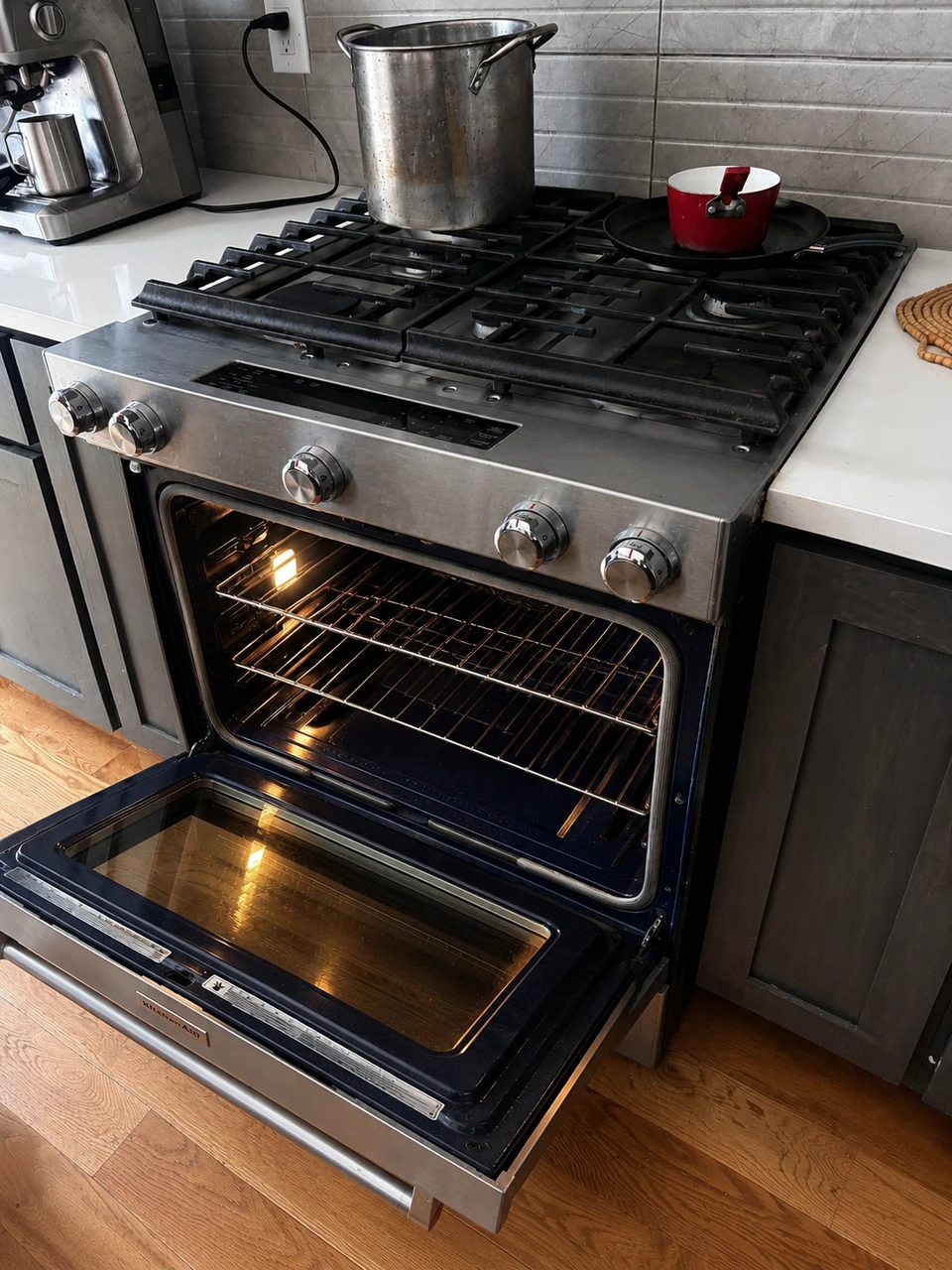
KitchenAid gas range, oven door open for testing 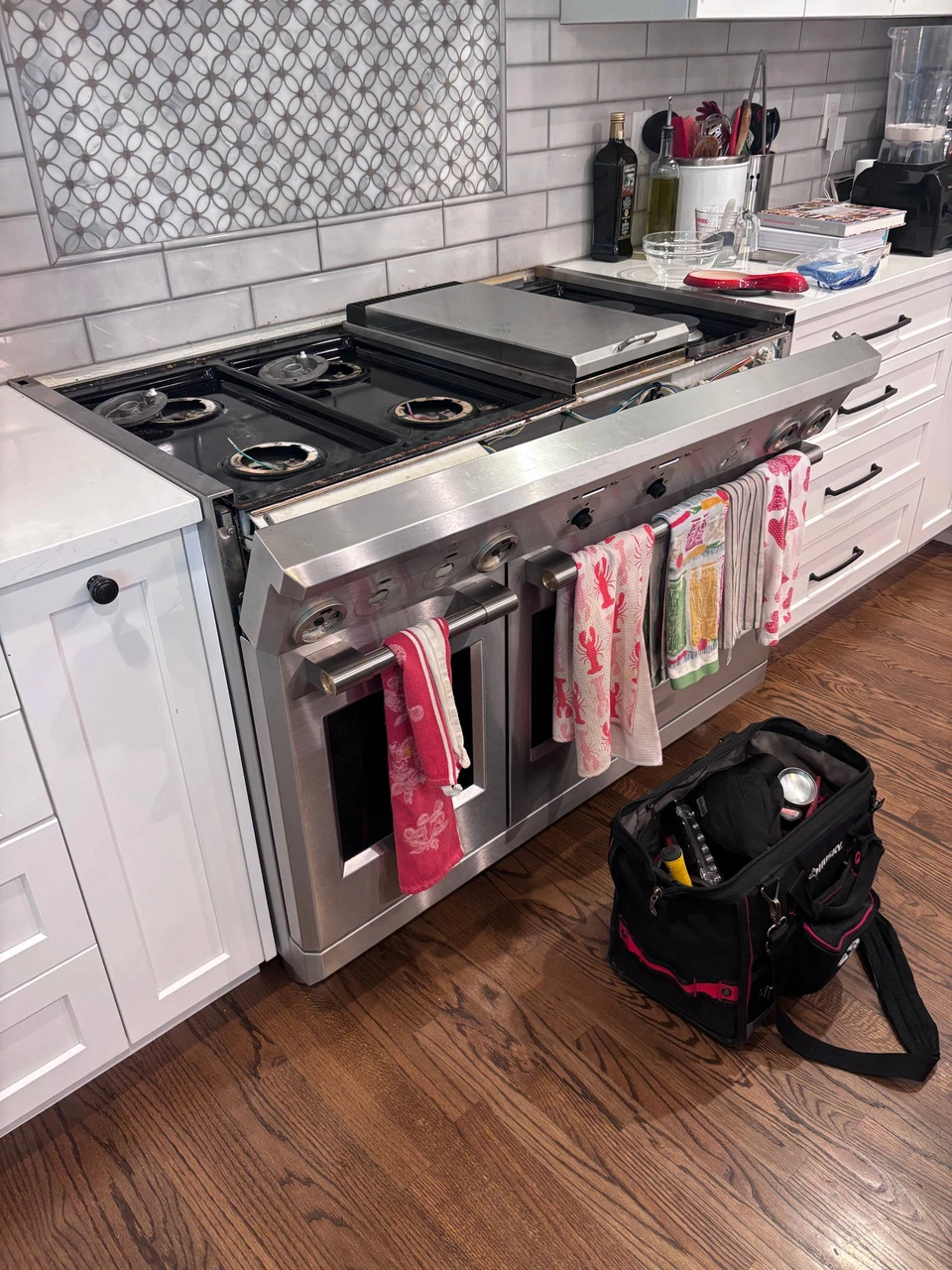
Pro-style range opened up — burners and controls 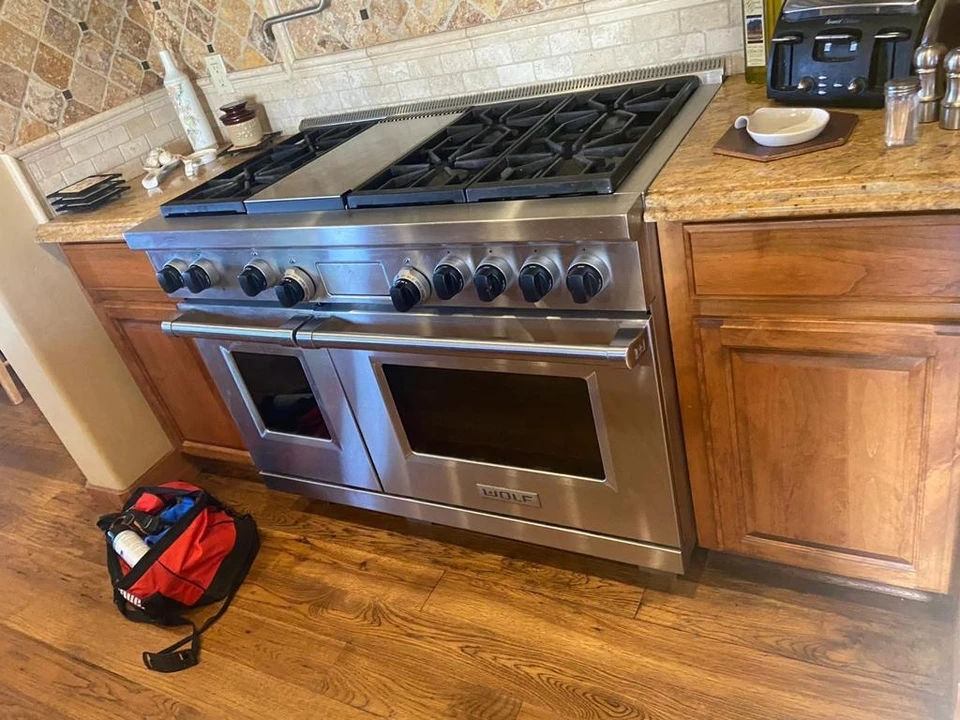
Wolf range with a griddle
Recognize the Problem?
Book Range & Stove Repair in Lafayette
Tell us what's happening — we'll call you back to confirm a time.
(720) 285-3573Lafayette Homes
What Your Range Faces in This Town
What a range deals with here comes down to the age of the house, the thin air and who is doing the cooking.
Old Town Character, Newer Cooktops
Old Town Lafayette pairs historic mining-era homes with newer townhomes, so the ranges in town span many decades of design. An older range may have simple knobs and mechanical switches, while one in a newer townhome often has a glass top, touch controls or a convection fan, and the faults differ accordingly. The model tag, usually on the frame or inside the oven door or drawer, tells your technician which parts apply. Age alone rarely decides anything; the condition of the parts does.
Thin Air Changes the Flame
Lafayette sits at 5,266 feet, where thinner air changes how gas and air mix at the burner. Many manufacturers publish high-altitude instructions for their gas ranges, and a range set up for a lower elevation can burn lazy, yellow or noisy here. A range that moved with you from a lower town deserves a setup check as well. We compare what your burners are doing against the maker's guidance for your model.
Townhomes, Condos and Rentals
In townhomes, condos and rented houses, the range is often older than the current cook, and someone else may own it. Settle who authorizes repairs before you book, and we will work with an owner, a property manager or a tenant. Long roasts and holiday baking in the colder months put steady demand on igniters and elements, which is when weak ones tend to give out.
Error Codes
Range Error Codes by Brand
Official codes from each manufacturer, with what to try first, are on our range & stove repair page. Common ones at a glance:
GE · Monogram
F1 · F2 · F3 and more
Samsung
door · -dE- · C-24 and more
Bosch
e011 · e005 · e101 and more
Dacor
C-d0 · C-d1 · C-21 and more
Thermador
E · E0211 · E11 and more
Wolf (range)
Err · Err · Err and more
Wolf (wall oven)
F1 · E10 · E17 and more
Repair or Replace?
How to Judge an Older Range
Use the NAHB lifespan figure shown beside this section as a rough yardstick, then look hard at the range in front of you. A ten-year-old range with one failed igniter is a different case from one with a cracked cooktop, a failing control board and an oven that has never held temperature. Compare the likely cost of the repair with the cost and trouble of a new range, and consider whether parts for your model are still easy to get. Energy use matters too, since an older oven that loses heat past a worn gasket works harder than it should.
Some factors tip the balance toward repair. Slide-in, built-in and custom-paneled ranges are fitted to the surrounding cabinets and countertop, so a replacement may need carpentry work to fit the opening. A premium range that has been well kept is often worth repairing as well. You'll get a straight explanation of the problem and a firm quote, and what happens next is entirely your call.
Typical range lifespan
~13–15 yrs
Source: NAHB study, electric–gas. Real life varies with brand, use and maintenance.
Built-In & Luxury
Premium Ranges Deserve Careful Hands
Our technicians service pro-style and dual-fuel ranges from Wolf, Thermador, Viking, Dacor, Monogram, JennAir and Miele. These machines have more to go wrong than a basic range: sealed burners that must align precisely, griddles and grills with their own igniters and controls, and dual-fuel ovens that combine a gas cooktop with electric baking. Your technician tests each system separately so the fault is pinned down before a part is ordered.
The oven doors on these ranges are heavy, and the hinges, springs and gaskets are built to carry that weight, so we handle them with care to protect your floors and cabinets. We use genuine OEM parts, because a premium range depends on components made for that exact model. Whether the problem is a sealed burner that will not light or a door that no longer closes squarely, the approach stays the same: test, explain, quote, then repair.
Before You Call
Five Safe Checks Before You Dial
- 1Glance at the breaker panelAn electric range that is completely dead may have a tripped breaker, and a gas range still needs power for its spark and clock.
- 2Wait out a wet cooktopAfter a boil-over or a deep clean, igniters and spark switches need time to dry before you decide anything has failed.
- 3Seat every burner capWith the range off and cool, set each cap flat and centered on its base, since a crooked cap is a frequent reason a burner will not light.
- 4Scan for a lock or timer settingA control lock, Sabbath mode or delayed start can make a working oven seem dead, so check the display before assuming a fault.
- 5Compare the flame colorA mostly blue, steady flame is normal, and noting yellow tips or a lifting flame gives your technician a useful head start.
Brands
Find Your Range's Maker Below
We repair everyday freestanding ranges and premium pro-style lines on gas, electric, dual-fuel and induction models. Pick your brand to view model notes and common error codes.
What to Expect
Once We Knock on Your Door
Your technician arrives within your scheduled window, asks what you've noticed, and tests the burners, igniters, elements and controls until the real fault is confirmed. Before any part is touched, you'll get a plain explanation and a firm quote.
- Diagnostic visit
- $85Credited toward the repair if you go ahead
- Your price
- Firm quoteApproved by you before any work
- Warranty
- 90 daysParts and labor
- Parts
- Genuine OEMMatched to your model number
Google Reviews
What Our Customers Say
5.0Every review on Google is five stars.
“Nick was here today to fix a very old dryer and a newer stove. He arrived on time, was efficient, friendly, tidy and very reasonably priced. Having an older home, we've had many repairman over the years, this is one I would absolutely recommend!”
Joanne L.June 2026 · Google “Nick came the same day I called! Had my oven door handle and gas stove fixed up in a jiffy, all with great communication and a friendly and helpful attitude. I'll definitely be calling him again for any appliance repair needs I have in the future.”
Suzanne N.September 2026 · Google “Great experience from start to finish. He repaired my older washer and dryer with skill and care, and I really appreciated how well he communicated throughout the process. He was always on time, professional, and easy to work with. I would definitely recommend his services to anyone needing appliance repairs.”
Robyn S.May 2026 · Google
Membership
PointLine Care Club
One service call is $85. For $99 a year, every service call is free.
- Free service calls all year — no $85 fee
- 1 free maintenance visit a year
- 10% off labor on every repair
$99/ year
One household · renews yearly · cancel anytime before renewal
Property manager or landlord? See our Property Care Club →
Service Area
Lafayette ZIP Codes We Serve
Range & Stove Repair at homes, condos and rentals in every part of Lafayette.
- 80026
Including Old Town Lafayette.
FAQ
Range Questions From Local Kitchens
Range questions from Lafayette homeowners.
Do you come to homes in ZIP code 80026?
Yes, 80026 is Lafayette's ZIP code and we serve it, along with the neighboring towns of Louisville, Erie and Broomfield. If you are unsure whether your address qualifies, call or text and we will confirm.
The flame on my newer gas range looks soft and a bit yellow; should I worry?
A mostly blue, steady flame is normal, and yellow tips or a lazy flame deserve a look. Dirty ports, a misadjusted air shutter or a range that never got its high-altitude setup can all cause it, and at 5,266 feet that last one is worth ruling out. Smelling gas is a different matter, so follow the safety steps above if you do.
Will an older range in an Old Town Lafayette kitchen be harder to repair?
Not necessarily, because age matters less than the condition of the parts and whether replacements are available. Your technician reads the model tag, tests the fault and tells you plainly whether a repair makes sense before you commit to anything.
My townhome oven stopped heating and I rent; who should I call?
Start with your landlord or property manager, since the range usually belongs to them and the lease may spell out who handles repairs. We can work with the owner, the manager or you once someone has approved the visit. Tell us the make and model if you can, because it helps us prepare.
Do you repair Wolf, Thermador or other pro-style ranges?
Yes, we repair pro-style and dual-fuel ranges made by Wolf, Thermador, Viking, Dacor, Monogram, JennAir and Miele. That includes sealed burners, griddles, grills and the heavy oven doors, all repaired with genuine OEM parts.
My oven takes longer to preheat than it used to; can it wait?
Usually it is not dangerous, but it should not wait long. A slow preheat often means a weakening igniter or element, which tends to fail completely at an inconvenient moment. If you ever smell gas or see a burner that will not shut off, stop and follow the safety steps instead of waiting.
More in Lafayette
Other Repairs We Handle in Lafayette
- Refrigerator Repair in Lafayette
- Freezer Repair in Lafayette
- Ice Maker Repair in Lafayette
- Wine Cooler Repair in Lafayette
- Washer Repair in Lafayette
- Dryer Repair in Lafayette
- Dryer Vent Cleaning in Lafayette
- Dishwasher Repair in Lafayette
- Oven Repair in Lafayette
- Wall Oven Repair in Lafayette
- Cooktop Repair in Lafayette
- Microwave Repair in Lafayette
- Range Hood Repair in Lafayette
- Garbage Disposal Repair in Lafayette
- Commercial Appliance Repair in Lafayette
Is your stove testing your patience tonight?
Pick a time online or call or text (720) 285-3573, and your technician will test the range, name the fault and give you a firm price before touching a part.