Louisville, Colorado
Oven Repair in Louisville, CO
Cold bake elements, tired igniters, wandering temperatures and stubborn latches, tested in your kitchen by neighbors from Superior, with a firm price up front.
What's your oven doing?

- Firm Quote FirstApproved by you before any work
- 90-Day WarrantyParts & labor
- Open 24/7Same-day service often available
- Local & Family-OwnedBased in Superior
Oven Repair • Louisville
The Appliance That Decides What's for Dinner
Most kitchen trouble can be worked around for a night or two, but a cold oven rewrites the menu on the spot. The lasagna sits raw, the sheet-pan vegetables steam instead of roasting, and the birthday cake waits for a plan B. We fix gas, electric, convection and self-clean ovens in single-family houses, condos and rental units throughout Louisville, from freestanding ranges to ovens set into a wall of cabinets. Our one office is at 2600 S Rock Creek Pkwy #103 in Superior, the family business right next door, so a call to us reaches people who work these same streets every week.
An oven earns a careful repair because its bones rarely fail. The steel body, the enameled cavity and the insulation packed around it can serve for many years, while the trouble usually lives in a handful of parts that take the heat directly: elements, igniters, safety valves, sensors, door locks and control boards. Replace the right one and the oven goes back to baking the way it did before. Replace the wrong one on a hunch and you pay twice, which is why your technician measures and tests before naming a part or a price.
Right Now
Gas Odor, Sparks or Flames: Act First, Fix Later
When an oven becomes a hazard, protecting people comes before any repair conversation.
#1
Cooking is the leading cause of home fires and fire injuries
37%
Nonconfined cooking fires where unattended equipment was the leading factor
- 1If you smell gas, get outLeave the house with everyone right away, and don't flip lights, unplug anything or touch the oven knobs, since one small spark can ignite gas. Once you're outside and clear of the home, call 911 or your gas utility. Wait until they tell you it's safe before you go back inside.
- 2If an element sparks or arcsSwitch the oven off at its controls, then flip its breaker at the electrical panel so the element receives no power whatsoever. Leave the breaker off and don't run the oven again until it has been inspected. A sparking element has usually burned through and needs replacing.
- 3If flames appear inside the ovenTurn off the heat and leave the door shut so the fire runs out of air. Move everyone back from the kitchen, and call 911 if the flames don't die down quickly. Opening the door feeds the fire fresh oxygen.
- 4Keep a lid close to the cooktopThe U.S. Fire Administration (USFA) reports that cooking is, by far, the leading cause of home fires and home fire injuries, and that unattended equipment was the leading factor in nonconfined home cooking fires, at 37%. Stay in the kitchen whenever a burner is on, and keep a pan lid or baking sheet within reach to slide over a pan that catches fire.
Common Problems
Reading the Signs Your Oven Is Giving You, and How We Respond
Each row reflects how ovens are commonly built. Your technician tests in place to confirm the real cause before you see any quote.
Cavity never gets hot
- Likely causes
- On electric models the culprit is often an open bake element, a hidden element beneath the oven floor or a temperature sensor that has failed. On gas models a weakening igniter or a tired safety valve can keep the burner from lighting at all.
- What we check
- Your technician checks element and sensor resistance, measures the igniter's current draw and confirms the control is actually sending power.
- Typical fix
- Replacing the failed element, igniter, sensor or valve with a genuine OEM part usually restores full heat in a single visit.
Gas oven clicks, glows or smells faintly but won't light
- Likely causes
- A glowing igniter can still pull too little current to open the gas valve, so the flame never appears. More rarely, the safety valve itself has failed, or the gas supply is being restricted.
- What we check
- We test igniter amperage, check voltage at the valve and look at burner ports and flame quality.
- Typical fix
- Most cases end with a new igniter, and sometimes a valve, followed by a test bake to confirm the burner lights cleanly every time.
Browning is patchy or the temperature runs off
- Likely causes
- A sensor that reads wrong, a convection fan that has slowed, a weak element or a door gasket leaking heat can all skew results. Calibration that drifted over time is also possible.
- What we check
- Your technician compares a thermometer reading to the setpoint, tests the sensor and fan motor and inspects the door seal.
- Typical fix
- The fix may be a sensor, fan motor, gasket or element, or simply a calibration adjustment when the hardware tests healthy.
Broiler stays dark while bake still works
- Likely causes
- The broil element may have an open circuit, a gas broil igniter may have weakened, or the control may have stopped powering that circuit. Since bake and broil share little hardware, one can fail alone.
- What we check
- We test the broil element or igniter directly and check the relay output on the control board.
- Typical fix
- Replacing the broil element or igniter is the usual repair; a board relay is replaced only after testing points there.
Latch holds the door after a cleaning cycle
- Likely causes
- The lock motor or lock switch can wear out under self-clean heat, or a sensor may never report that the cavity has cooled. A stuck relay can also keep the lock engaged.
- What we check
- Your technician tests the lock motor and switches and reads the sensor once the oven is fully cool.
- Typical fix
- A new lock assembly or sensor typically frees the door, and we confirm the lock releases properly before we leave.
Keypad ignores you or a code keeps returning
- Likely causes
- The panel can go dark when the membrane keypad wears out, a ribbon cable works loose or the control board begins to fail. Repeating codes often trace to a sensor reading out of range or a door lock fault.
- What we check
- We read the code, check cable connections and test the keypad, sensor and lock circuits before suspecting the board.
- Typical fix
- Depending on the test results, the repair may be a keypad, a cable reseat, a sensor or a control board.
Self-Clean, Calibration & Altitude
Sorting Normal Oven Habits From Real Failures
Many oven complaints trace back to the cycle you chose, the settings or the recipe rather than a broken part. These notes help you tell the difference and know where your checks should stop.
Self-Clean Takes Its Toll
A self-clean cycle drives the cavity far past any baking temperature so food residue turns to ash. All of that heat reaches the elements, the sensor, the door lock and the control board at the very same time. Run it only as often as your manual recommends, wipe up loose spills first, and avoid starting it right before a big cooking day. If a part is close to failing, self-clean is often the cycle that finishes it off.
A Locked Door Isn't Always a Broken One
The latch is designed to stay engaged until the cavity cools to a safe temperature, and that wait can stretch longer than people expect. Give the oven time, and never pry the door or force the handle. When the oven feels cold and the door still won't open, suspect the lock motor, the lock switch or the sensor. That is the point to call rather than keep trying.
Trust a Thermometer Before Adjusting Anything
The temperature shown on the display is only the oven's own estimate. Set an inexpensive oven thermometer in the center of the middle rack, let the oven finish a full preheat, and take a few readings over several minutes, since ovens cycle above and below the setpoint. Many models let you calibrate a small offset through the settings menu, as your manual describes. A large or erratic gap suggests a failing sensor or control and calls for testing.
Convection, Gas Setup and Baking at Altitude
Some ovens lower the set temperature automatically in convection mode, which can look like a fault if you aren't expecting it. At higher elevations a gas oven may need a high-altitude setup from the manufacturer, and that adjustment is a job for a technician rather than the homeowner. Batters that rise fast and then collapse, or cakes that dry at the edges, are usually a recipe matter at this altitude. Adjusting leavening, liquid or bake time fixes those, while a thermometer confirms the oven itself is honest.
From Our Own Jobs
Real Oven Repairs From Our Own Jobs
Real photos from our own service calls around the Denver Metro Area — not stock images.
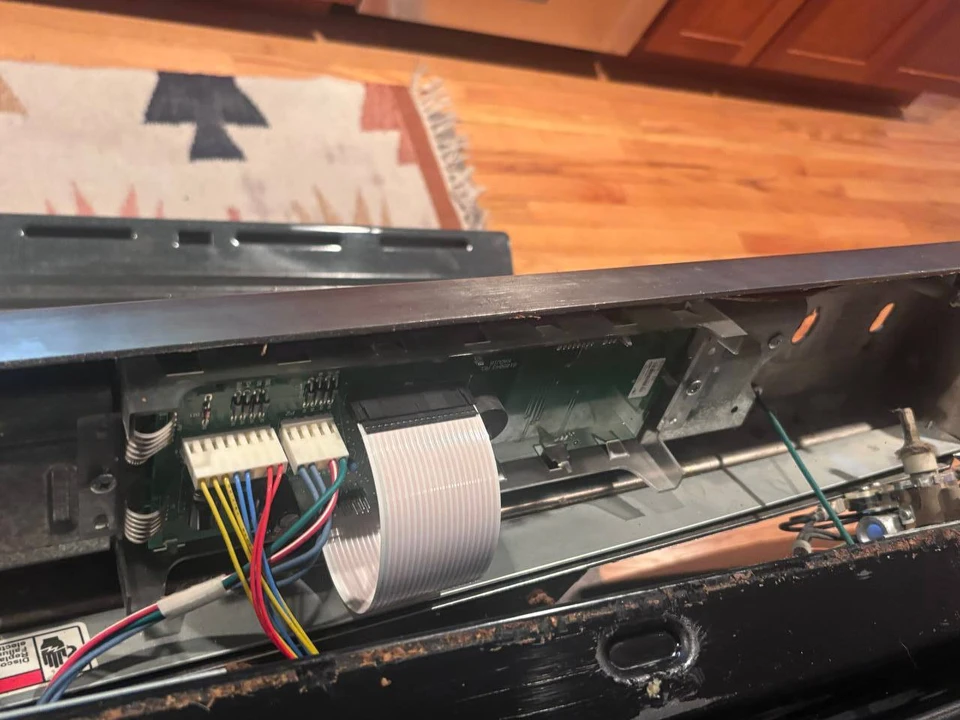
Control panel opened — checking the board and ribbon cable 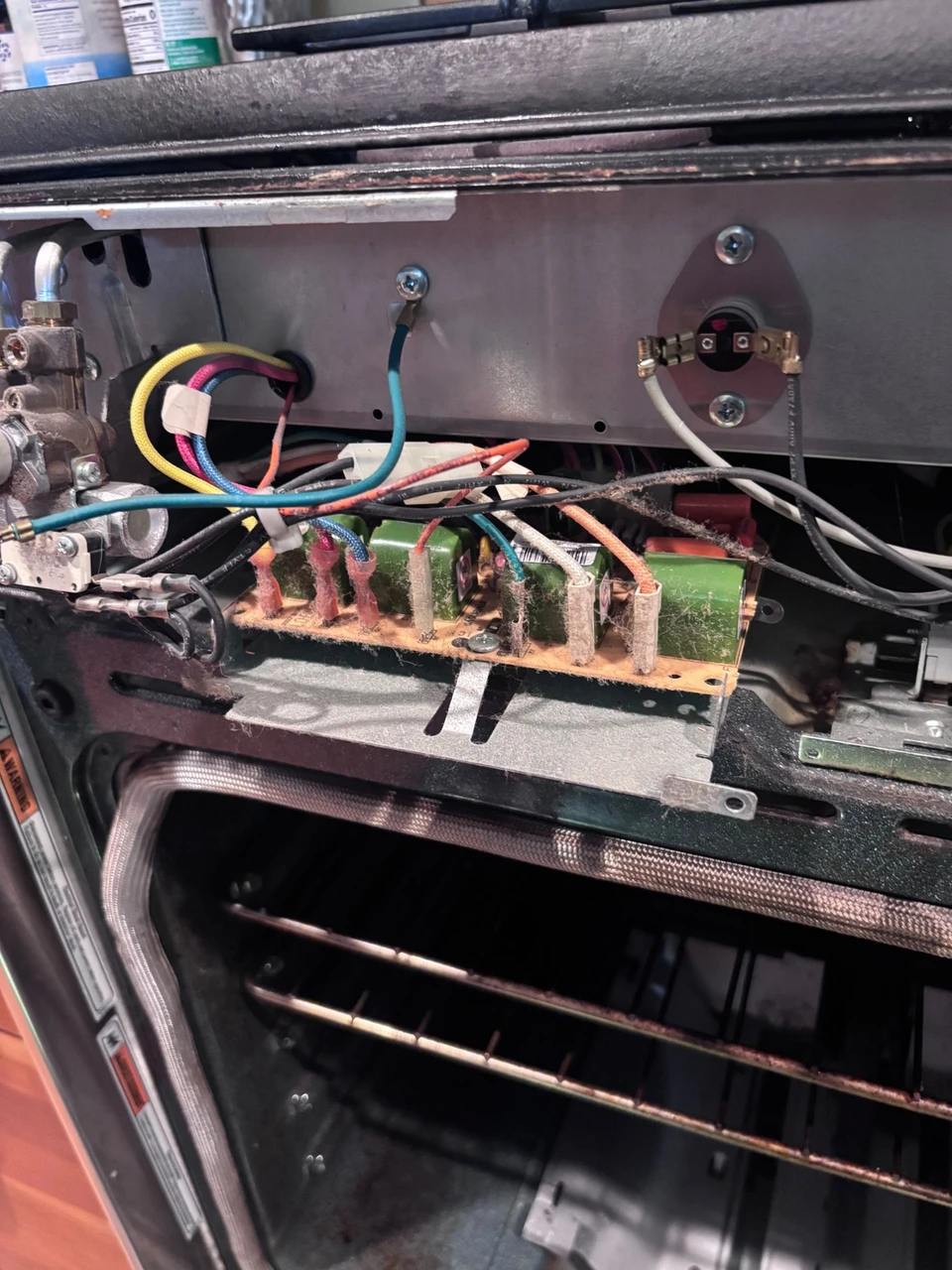
Relay board and wiring exposed during diagnosis 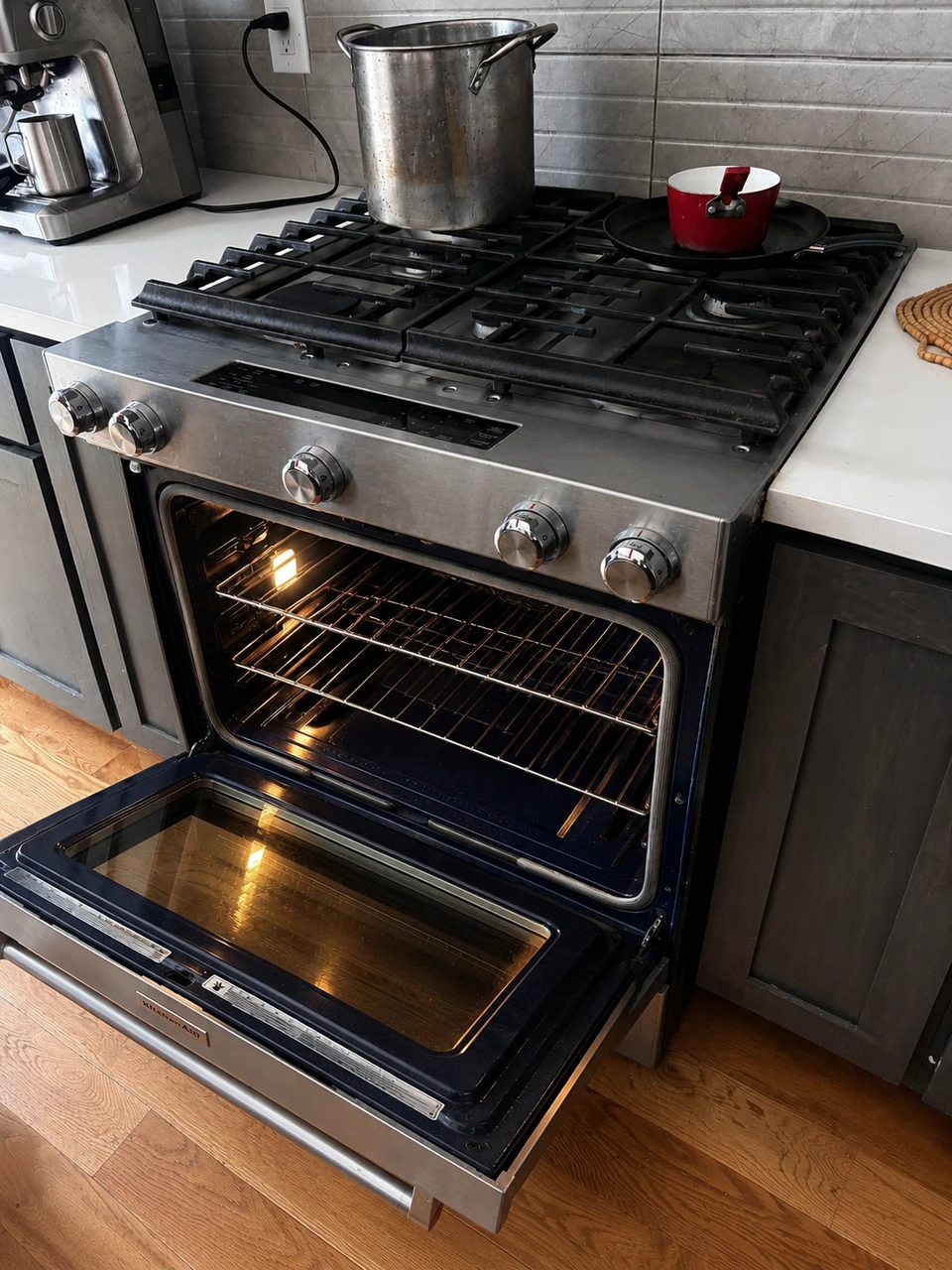
KitchenAid gas range, oven door open for testing
Recognize the Problem?
Book Oven Repair in Louisville
Tell us what's happening — we'll call you back to confirm a time.
(720) 285-3573Louisville Homes
Rebuilt Homes, an Old Main Street and Mile-High Air
Three things about this town shape how its ovens age and where your technician starts looking.
New Ovens in Rebuilt Houses
After the Marshall Fire in December 2021, many Louisville homes that were lost or damaged have been rebuilt, and a lot of them now have brand-new appliances. A new oven is not immune to trouble; early faults tend to show up as control errors, a sensor reading out of range or a door lock that misbehaves after the first few self-clean cycles. Many of these units may still be under the manufacturer's warranty, so keep the purchase paperwork handy. Your technician can confirm what failed and tell you plainly whether the fix belongs with us or with the maker.
Established Kitchens Around Main Street
Historic Downtown Louisville, home to Steinbaugh Pavilion, is one of the areas we serve, and the longer-standing houses near it may hold ovens that have worked through years of holidays. Older units generally wear in predictable places: bake elements that blister, door gaskets that flatten and sensors that drift. Parts for many older models are still available, and a well-built range is often worth another round of repair. When a part has gone scarce, we say so before you spend anything.
Thin, Dry Air at 5,401 Feet
At about 5,401 feet, water boils at a lower temperature and Colorado's dry air pulls moisture out of batters and roasts faster than a sea-level recipe expects. That means a sunken cake is sometimes a recipe issue rather than an oven fault. Gas ovens are a separate matter, because burners at higher elevations may need a high-altitude setup specified by the manufacturer. An oven thermometer reading tells you which problem you actually have.
Error Codes
Oven Error Codes by Brand
Official codes from each manufacturer, with what to try first, are on our oven repair page. Common ones at a glance:
GE · Monogram
F1 · F2 · F3 and more
Samsung
door · -dE- · C-24 and more
Bosch
e011 · e005 · e101 and more
Dacor
C-d0 · C-d1 · C-21 and more
Thermador
E · E0211 · E11 and more
Wolf (range)
Err · Err · Err and more
Wolf (wall oven)
F1 · E10 · E17 and more
Repair or Replace?
Another Repair, or Time for a New Oven?
The typical lifespan figure beside this section comes from a National Association of Home Builders study, and it describes an average oven rather than predicting the end of yours. A single failed igniter, element or sensor on a sound oven is usually worth fixing, because those parts cost a fraction of a new unit and the rest of the machine still has years in it. The picture shifts when several systems fail at once, when the cavity enamel or door frame is damaged, or when the repair would come close to the price of a comparable replacement. Your technician lays out those numbers before you decide, with no pressure either way.
Where the oven is installed counts for as much as how old it is. For built-in wall ovens and models with custom panels, repair is usually the better route, because a replacement must fit the existing cutout, the electrical or gas supply and the surrounding trim, and any mismatch can turn into cabinet work. Parts availability counts too: if a key component for an older model has gone scarce, we tell you up front rather than chase it on your time. Newer ovens can also bring better insulation and more accurate controls, which is worth weighing when the old one is already on borrowed time.
Typical oven lifespan
~13–15 yrs
Source: NAHB study, electric–gas. Real life varies with brand, use and maintenance.
Built-In & Luxury
Wolf, Thermador, Miele and Other Built-In Ovens
Ovens from Wolf, Thermador, Miele, Viking, Dacor, Monogram and JennAir tend to be framed tightly by cabinetry, with narrow reveals, matching panels and finished trim. Some repairs require easing the unit out of its opening, which means supporting a heavy oven properly, protecting face frames and finishes, and handling the electrical connection with care. Rushed removal can chip wood or scratch a panel that is difficult to match, so your technician takes the slow, deliberate route. Many fixes on these lines can be done from the front without pulling the oven at all, and we check that first.
Steam ovens and speed ovens carry extra systems that a standard oven doesn't have. A steam oven brings water reservoirs or plumbed supply lines, pumps and a steam generator, and it should be descaled on the schedule in its manual; a speed oven combines microwave components with conventional heat, and those high-voltage parts are for a technician only. We install genuine OEM parts on these models, because premium controls and sensors are calibrated as a set and generic substitutes can throw off the whole system.
Before You Call
Five Things Worth Trying Before You Book
- 1Look at the breaker panelMany electric ovens run on a double breaker, so one tripped half can leave the clock lit while the elements stay cold; reset it just once, and only if there was no burning smell or spark.
- 2Turn off control lock and special modesIf a keypad lock, Sabbath mode or a forgotten delay-start timer is active, a working oven can ignore every button you press, and your manual explains how to turn each one off.
- 3Light a burner on a gas rangeIf the cooktop burners won't light either, check that the shutoff valve behind the range is open, since the problem may be the gas supply and not the oven itself.
- 4Take a thermometer readingTake a few readings from the middle rack after a full preheat to see whether the oven is truly running off temperature or the recipe simply needs an altitude adjustment.
- 5Inspect the element and door seal while coolA blistered or cracked bake element, or a torn or flattened gasket, is a strong clue, and mentioning it when you book helps your technician bring the right part.
Brands
The Oven Brands We Work On
We fix everyday ranges and wall ovens from Whirlpool, GE, Frigidaire, KitchenAid, Maytag, LG and Samsung, as well as premium built-in lines. Pick your brand below for model notes and common error codes.
What to Expect
What Happens When Your Technician Arrives
Book online or call or text (720) 285-3573, pick an arrival window, and your technician comes with tools and common parts, listens to what the oven has been doing and tests the suspect components in place. We explain in plain terms what failed and give you a firm price, and nothing gets started until you give the go-ahead.
- Diagnostic visit
- $85Credited toward the repair if you go ahead
- Your price
- Firm quoteApproved by you before any work
- Warranty
- 90 daysParts and labor
- Parts
- Genuine OEMMatched to your model number
Google Reviews
What Our Customers Say
5.0Every review on Google is five stars.
“Nick was here today to fix a very old dryer and a newer stove. He arrived on time, was efficient, friendly, tidy and very reasonably priced. Having an older home, we've had many repairman over the years, this is one I would absolutely recommend!”
Joanne L.June 2026 · Google “Nick came the same day I called! Had my oven door handle and gas stove fixed up in a jiffy, all with great communication and a friendly and helpful attitude. I'll definitely be calling him again for any appliance repair needs I have in the future.”
Suzanne N.September 2026 · Google “Nick was excellent. He was able to come out the same day as I discovered that my 21 year old refrigerator had been leaking for weeks or months. He was able to diagnose the problem quickly, ordered the part immediately, and was available within a couple of days to install the new part and finish the repair work. He was on time for both appointments, and called in advance. It’s hard to find people like this these days, I will highly recommend him and use him again if I have additional appliance failures.”
Noreen B.June 2026 · Google
Membership
PointLine Care Club
One service call is $85. For $99 a year, every service call is free.
- Free service calls all year — no $85 fee
- 1 free maintenance visit a year
- 10% off labor on every repair
$99/ year
One household · renews yearly · cancel anytime before renewal
Property manager or landlord? See our Property Care Club →
Service Area
Louisville ZIP Codes We Serve
Oven Repair at homes, condos and rentals in every part of Louisville.
- 80027
Including Historic Downtown Louisville.
Related Repair Guides
FAQ
Oven Questions From Around Town
Oven questions from Louisville homeowners.
Is my street in 80027 on your route?
Yes, we serve addresses throughout 80027, including Historic Downtown Louisville and the rebuilt neighborhoods. Our office is right next door in Superior, and same-day visits are often possible, though we can't guarantee them.
We rebuilt after the Marshall Fire, and our new oven is already throwing a code. Is that normal?
A new oven can fail early, usually in a sensor, door lock or control board. Check whether the manufacturer's warranty still applies before booking, and if it doesn't, your technician can read the code, test the related circuit and quote the fix.
Is an older oven near Historic Downtown worth repairing?
Often yes, as long as the cavity and door are sound and parts are still available. Elements, gaskets, igniters and sensors are routine replacements on older models, and we tell you up front if a part has become hard to find.
Does a gas oven need different settings at 5,401 feet?
It may, because gas burners at higher elevations can need a high-altitude setup per the manufacturer. A soft, lazy or yellow-tipped flame is worth having checked, and that adjustment should be done by a technician.
My tenant reports the oven won't heat. How do you handle rentals?
Your tenant can book the visit and let us in, and the quote goes to whoever you designate before any work starts. Tell us when booking who approves repairs so nothing waits on a phone tag.
The oven still bakes but runs hot and smells odd. Can it wait?
A slight temperature drift can usually wait a few days, but a burning or electrical smell should not. Turn the oven off at its breaker if it smells electrical, and book a visit rather than keep testing it.
More in Louisville
Other Repairs We Handle in Louisville
- Refrigerator Repair in Louisville
- Freezer Repair in Louisville
- Ice Maker Repair in Louisville
- Wine Cooler Repair in Louisville
- Washer Repair in Louisville
- Dryer Repair in Louisville
- Dryer Vent Cleaning in Louisville
- Dishwasher Repair in Louisville
- Wall Oven Repair in Louisville
- Range & Stove Repair in Louisville
- Cooktop Repair in Louisville
- Microwave Repair in Louisville
- Range Hood Repair in Louisville
- Garbage Disposal Repair in Louisville
- Commercial Appliance Repair in Louisville
Ready to cook in a reliable oven again?
Book online or call or text (720) 285-3573, and a family company from next-door Superior will test your oven and give you a firm price before any work begins.